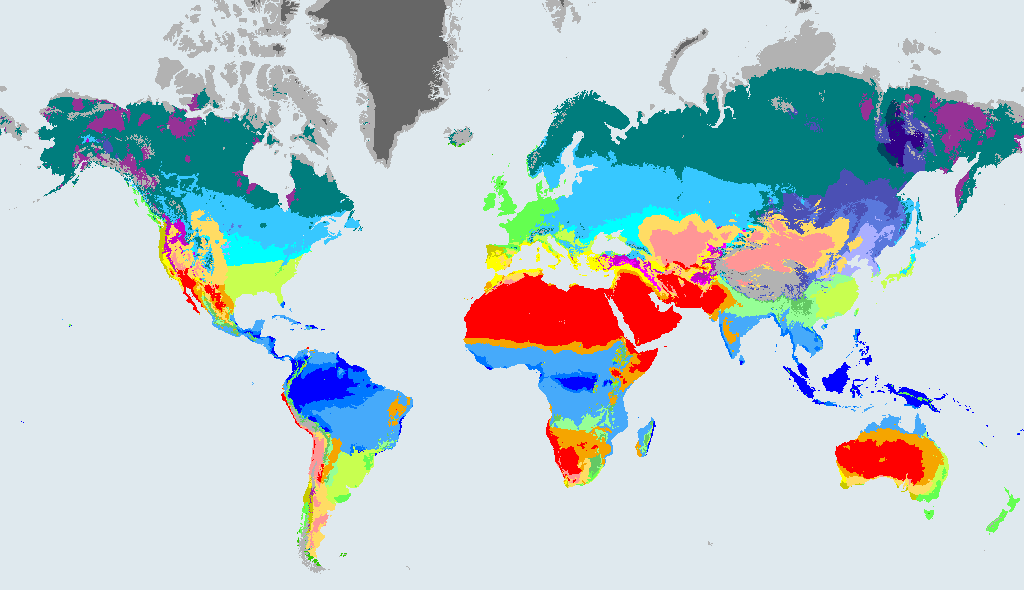
The climate of Marrakesh
BSh Hot semi-arid (steppe). Dry and hot, but with enough rain for grass. A band of dry grassland and scrub, usually found on the edges of hot deserts. It gets more rain than a desert, but still not enough for most trees.
Marrakesh is north of the equator, so summer falls in June to August and winter in December to February. The 1901 to 1930 map puts Marrakesh in the same zone, BSh.
Marrakesh: then, now and by 2100
| Map | Climate zone | Compared with now |
|---|---|---|
| 1901 to 1930 | BSh Hot semi-arid (steppe) | Same as now |
| 1991 to 2020 (now) | BSh Hot semi-arid (steppe) | - |
| 2071 to 2099, SSP1-2.6 (low emissions) | BSh Hot semi-arid (steppe) | Same as now |
| 2071 to 2099, SSP2-4.5 (middle of the road) | BWh Hot desert | Different from now |
| 2071 to 2099, SSP5-8.5 (high emissions) | BWh Hot desert | Different from now |
The 2071 to 2099 rows are model projections under three emissions scenarios, not forecasts. The 1901 to 1930 row is a reconstruction. All come from Beck et al. (2023).
Under the middle-of-the-road scenario (SSP2-4.5), the model puts Marrakesh in BWh (hot desert) in 2071 to 2099, instead of BSh now. Under the high-emissions scenario (SSP5-8.5) it is BWh (hot desert).
Cities with the same climate as Marrakesh
Other big cities that are BSh (hot semi-arid (steppe)) in 1991 to 2020, at most two per country:
Where Marrakesh's future climate exists today
In the SSP2-4.5 map for 2071 to 2099, Marrakesh is BWh. These cities are BWh in 1991 to 2020, so they give a rough idea of the future climate (the real conditions would differ in many ways).
More
Population of Marrakesh from GeoNames: 995,871 (rank 578 in our list of 1,000). Climate data: Beck et al. (2023), CC BY 4.0. Data sources and licences.