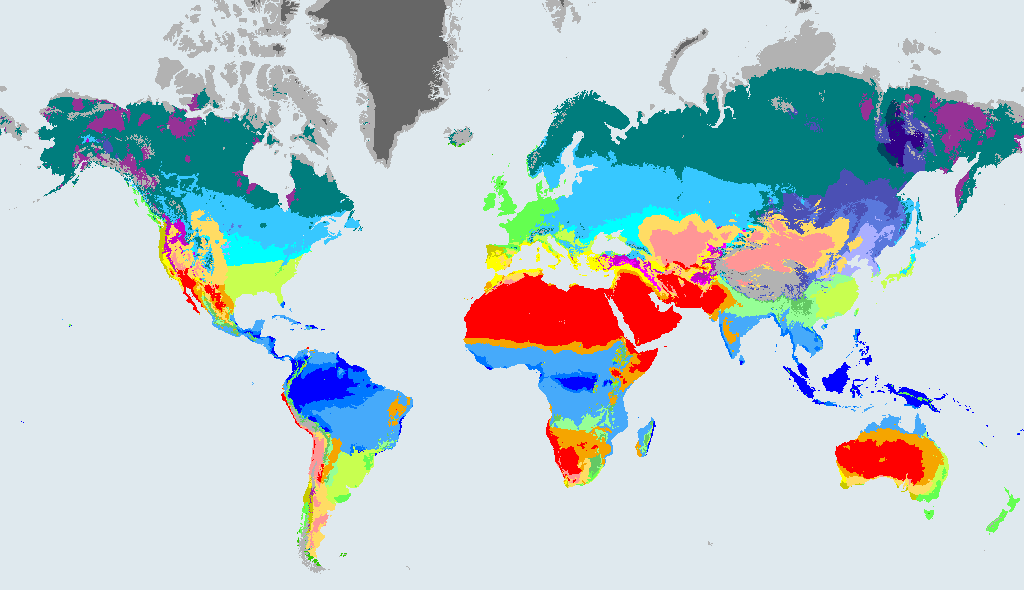
The climate of Rio de Janeiro
Aw Tropical savannah. Hot all year, with a clear dry season. Warm throughout, with a wet season and a distinct dry season long and dry enough for grassland and scattered trees rather than closed forest.
The 1901 to 1930 map puts Rio de Janeiro in the same zone, Aw.
Rio de Janeiro: then, now and by 2100
| Map | Climate zone | Compared with now |
|---|---|---|
| 1901 to 1930 | Aw Tropical savannah | Same as now |
| 1991 to 2020 (now) | Aw Tropical savannah | - |
| 2071 to 2099, SSP1-2.6 (low emissions) | Aw Tropical savannah | Same as now |
| 2071 to 2099, SSP2-4.5 (middle of the road) | Aw Tropical savannah | Same as now |
| 2071 to 2099, SSP5-8.5 (high emissions) | Aw Tropical savannah | Same as now |
The 2071 to 2099 rows are model projections under three emissions scenarios, not forecasts. The 1901 to 1930 row is a reconstruction. All come from Beck et al. (2023).
Under the middle-of-the-road scenario (SSP2-4.5), the model keeps Rio de Janeiro in Aw in 2071 to 2099. The high-emissions scenario (SSP5-8.5) gives the same answer.
Cities with the same climate as Rio de Janeiro
Other big cities that are Aw (tropical savannah) in 1991 to 2020, at most two per country:
- Kinshasa, Democratic Republic of the Congo
- Lagos, Nigeria
- Ho Chi Minh City, Vietnam
- Bengaluru, India
- Hyderabad, India
- Dar es Salaam, Tanzania
- Bangkok, Thailand
- Kano, Nigeria
More
Population of Rio de Janeiro from GeoNames: 6,747,815 (rank 51 in our list of 1,000). Climate data: Beck et al. (2023), CC BY 4.0. Data sources and licences.