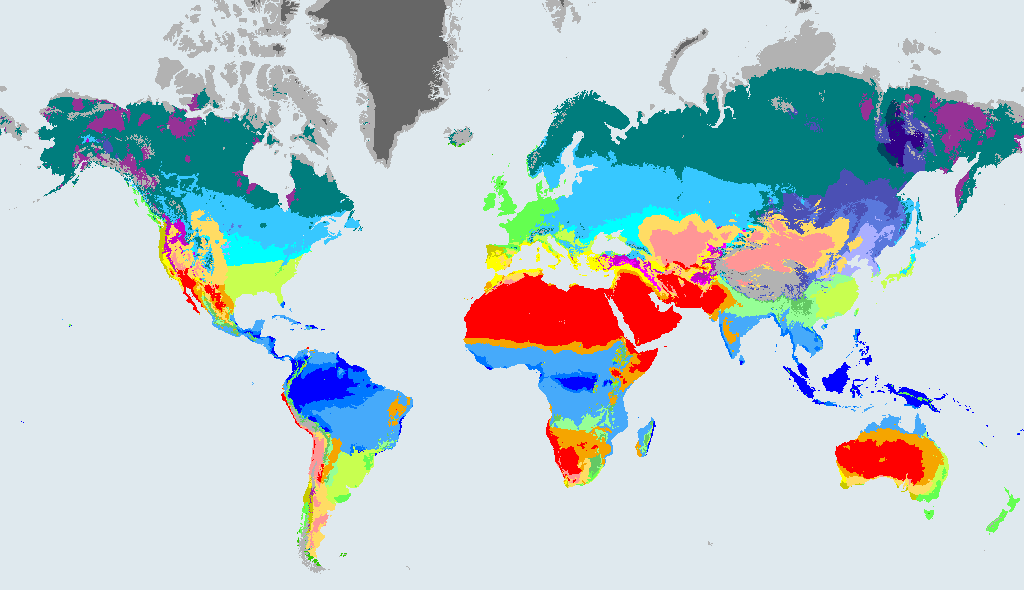
What a Dsc climate is like
Dsc Subarctic with dry summer. A rare climate of high mountains, with a freezing winter and a brief, dry, cool summer.
The rules behind the code, in plain English:
- Cold (coldest month at or below 0 °C).
- Dry summer: the driest summer month gets under 40 mm and under a third of the wettest winter month.
- Cold summer: not hot or warm, and the coldest month is not below -38 °C.
Dataset wording: "Cold, dry summer, cold summer". In the maps of Beck et al. (2023) the class is written: D: Not B and Thot > 10 and Tcold <= 0; s: Psdry < 40 and Psdry < Pwwet/3; c: Not (a, b or d).
Subarctic climate with a dry summer has cold winters and short, cool summers that are dry in the warmer months. It is found at height, often in mountains near drier regions. Hardy conifers and tough grasses grow, and the growing season is brief. Snow lasts for much of the year, so warm clothes and well-insulated buildings are the norm.
How much of the world is Dsc?
- 1.2%of the world's land outside Antarctica, 1991 to 2020
- 1,607,150 km²area, 1991 to 2020
- 7cities of 15,000 or more people (GeoNames) have this climate now
In 1901 to 1930 it covered 0.9% of that land, so its area then was 28.42% smaller than in 1991 to 2020.
How the Dsc area is projected to change by 2071 to 2099
These figures compare the area of Dsc in each future map with 1991 to 2020. They come from the Beck et al. (2023) model projections under three emissions scenarios. They show what the scenarios imply, not what will happen.
| Map | Share of land | Change in area vs 1991 to 2020 |
|---|---|---|
| 1901 to 1930 (past) | 0.9% | -28.42% |
| 1991 to 2020 (now) | 1.2% | - |
| 2071 to 2099, SSP1-2.6 (low emissions) | 1.1% | -12.08% |
| 2071 to 2099, SSP2-4.5 (middle of the road) | 1.1% | -6.87% |
| 2071 to 2099, SSP5-8.5 (high emissions) | 1.3% | +5.68% |
Shares are of land outside Antarctica. A negative change means the zone shrinks.
What happens to today's Dsc land
Of the land that is Dsc in 1991 to 2020, this is how much stays Dsc and where the rest ends up in 2071 to 2099, by scenario:
| Scenario (2071 to 2099) | Stays Dsc | Where the rest goes (biggest first) |
|---|---|---|
| SSP1-2.6, low emissions | 63% | Dfc (22%), Dsb (11%), Dfb (3.4%) |
| SSP2-4.5, middle of the road | 57% | Dsb (18%), Dfc (17%), Dfb (7%), Csb (0.8%) |
| SSP5-8.5, high emissions | 49% | Dsb (28%), Dfb (11%), Dfc (8.8%), Csb (1.7%), Dsa (0.6%) |
Looking back, 43% of today's Dsc land was also Dsc in 1901 to 1930. The rest was Dfc (37%), ET (13%), Dfd (4%), Dsd (2.9%).
Where Dsc is found
The countries with the most Dsc land in 1991 to 2020:
| Country | Area | Share of all Dsc | Share of the country |
|---|---|---|---|
| Russia | 655,173 km² | 41% | 3.9% |
| Canada | 559,516 km² | 35% | 5.7% |
| United States | 240,274 km² | 15% | 2.6% |
| Afghanistan | 49,401 km² | 3.1% | 7.7% |
| Argentina | 26,806 km² | 1.7% | 1% |
| Tajikistan | 16,979 km² | 1.1% | 12% |
| Chile | 13,415 km² | 0.8% | 1.9% |
| Kyrgyzstan | 13,282 km² | 0.8% | 6.7% |
Places with a Dsc climate today
The biggest cities in the 1991 to 2020 map that sit in Dsc (at most two per country):
- Magadan, Russia
- Whitehorse, Canada
- Okha, Russia
- Padam, India
- Eagle River, United States
- Akureyri, Iceland
Other cold (continental) climates (group D)
- Dsa Hot-summer continental with dry summer
- Dsb Warm-summer continental with dry summer
- Dsd Subarctic with dry summer and very cold winter
- Dwa Hot-summer continental with dry winter
- Dwb Warm-summer continental with dry winter
- Dwc Subarctic with dry winter
- Dwd Subarctic with dry winter and very cold winter
- Dfa Hot-summer humid continental
- Dfb Warm-summer humid continental
- Dfc Subarctic (boreal)
- Dfd Subarctic with very cold winter
- All 30 zones
Frequently asked questions
What does Dsc mean in the Köppen climate classification?
Cold (coldest month at or below 0 °C). Dry summer: the driest summer month gets under 40 mm and under a third of the wettest winter month. Cold summer: not hot or warm, and the coldest month is not below -38 °C. The code is a short way of writing that: the first letter is the major group (D, cold (continental)) and the letters after it say more about rain and temperature.
What is a subarctic with dry summer climate like?
Cold, short summers, dry in the warm months. A rare climate of high mountains, with a freezing winter and a brief, dry, cool summer.
How much of the world has a Dsc climate?
1.2% of the world's land outside Antarctica was Dsc in 1991 to 2020, about 1,607,150 km² (Beck et al. 2023, 1 km maps).
Will the Dsc climate zone grow or shrink?
Under the middle-of-the-road scenario (SSP2-4.5), the area of Dsc in 2071 to 2099 is 6.87% smaller than in 1991 to 2020. This is a model projection, not a forecast, and it differs under other scenarios (see the table on this page).
Data: Beck et al. (2023), CC BY 4.0. See data sources and licences. Köppen-Geiger classes describe long-term averages, not weather.